
If you’ve landed on this post, you might be wondering about GDPR for US companies. “Why is a US-based company writing about GDPR and European privacy laws?” It’s a fair question. We’re headquartered in the United States, we primarily serve US clients, and we don’t have offices in Brussels or Berlin.
So why do we care so much about privacy frameworks that technically don’t apply to us?
The short answer: because privacy isn’t just about legal compliance. It’s about doing business the right way. But there’s more to it than that, and understanding why global privacy laws matter for US companies can help you make better decisions about your own business practices.
GDPR Has Become the De Facto Global Standard for Privacy
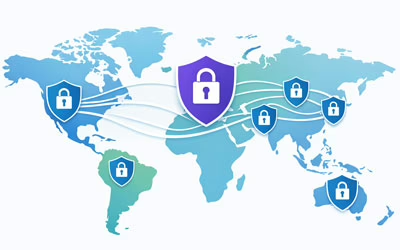
Here’s something that surprised us when we started researching privacy regulations: GDPR isn’t just a European thing anymore. Since the General Data Protection Regulation took effect in 2018, it has become the blueprint for privacy legislation worldwide.
Look at what’s happened in the United States alone. California’s CPRA, Colorado’s Privacy Act, Virginia’s VCDPA, Connecticut’s CTDPA. These state-level privacy laws didn’t emerge from a vacuum. They borrowed heavily from GDPR’s core principles: data minimization, purpose limitation, transparency, and individual rights.
Even if you never serve a single customer in Europe, GDPR’s influence is shaping the privacy landscape right here at home. Understanding GDPR for US companies means you’re already halfway to understanding US state privacy laws. And with more states passing their own privacy legislation every year (Maryland, Montana, Oregon, Texas, Tennessee, Delaware, Iowa, New Hampshire, New Jersey), the list keeps growing.
Thinking about privacy holistically just makes sense. We track over 150 different privacy, cookie, disclaimer, and terms of service regulations across multiple jurisdictions. What we’ve learned is that while the details vary, the core principles remain remarkably consistent. GDPR helped establish those principles globally.
Federal Privacy Legislation Keeps Following GDPR’s Lead
It’s not just state laws following GDPR’s lead. The American Privacy Rights Act was a bipartisan federal privacy bill that included rights to access data, delete data, correct data, restrict processing, and opt out of data collection. Sound familiar? These are the same core rights that GDPR established back in 2018. The bill expired when Congress adjourned in January 2025, but it represented the closest the US has come to comprehensive federal privacy legislation.
The pattern is clear: every serious federal privacy proposal borrows heavily from GDPR principles. Whether the next attempt passes as written or gets modified, the direction is unmistakable. US privacy law is converging around GDPR-style principles. When (not if) federal legislation finally passes, understanding GDPR for US companies will be essential, and businesses that already grasp these principles will have a massive head start.
Our partner Termageddon maintains a comprehensive privacy bill tracker that monitors proposed legislation at the federal, state, and international level. The landscape is changing fast, and new bills are introduced regularly.
We’re Ready to Work With International Clients
Our client base isn’t limited by geography, and yours probably isn’t either, even if you think it is.
We work with clients in the United Kingdom who need UK-GDPR compliance (yes, post-Brexit UK has its own version that’s nearly identical to EU GDPR). The internet doesn’t respect borders. Even if you’re a small business in Ohio, you might have customers in Toronto, website visitors from London, or clients in Sydney. Understanding GDPR for US companies means being ready to serve customers anywhere.
Flexible hosting architecture means clients can choose their preferred region, and modern business increasingly means being ready to serve customers wherever they happen to be. Building privacy-conscious practices from the start means you don’t need to scramble to understand new regulations when an international opportunity comes knocking. You’ve already got the foundation in place.
We’ve written extensively about this in our European Website Disclaimers series, which covers country-specific requirements across the UK, Ireland, Germany, Poland, and Italy. If you’re curious about regional differences in disclaimer requirements, that’s a good place to start.
Users Everywhere Expect Transparency About Their Data
Here’s the thing about privacy: your customers care about it regardless of what the law says.
In 2026, people are more aware of how their data is collected, used, and shared than ever before. They’ve read the headlines about data breaches. They’ve deleted apps over privacy concerns. They’re paying attention to how businesses handle their information.
When you’re transparent about your data practices (when you clearly explain what information you collect, why you collect it, how you use it, and who you share it with) you build trust. That trust translates into customer loyalty, better conversion rates, and fewer support headaches.
Privacy expectations are global. Whether your customer is in Kansas City or Manchester, they appreciate knowing what happens to their email address when they sign up for your newsletter. They want to understand how their payment information is secured. They care about whether you’re selling their data to third parties.
Meeting these expectations isn’t about checking a legal compliance box. It’s about respecting your customers and operating with integrity.
Privacy Is Just Good Business Practice
Let’s be honest: you shouldn’t need a legal mandate to tell people what you’re doing with their information.
This is where we get a little philosophical. Privacy-conscious business practices aren’t complicated or burdensome. They’re simply about being straightforward with your customers. Why wouldn’t you tell people what data you collect? Why wouldn’t you explain how you use it? Why wouldn’t you give people control over their own information?
The businesses that thrive in the long term are the ones that build trust with their customers. And trust is built through transparency, consistency, and respect. Privacy policies shouldn’t be intimidating walls of legalese designed to hide what you’re doing. They should be clear, readable documents that demonstrate you have nothing to hide.
When you approach privacy as a core business value rather than a legal obligation, something interesting happens: compliance becomes easier. You’re not trying to figure out the minimum you can get away with. You’re building systems that respect user data by default.
This mindset shift matters because privacy regulations will continue to evolve. New states will pass new laws. International frameworks will be updated. But if your foundation is solid (if you’re already committed to transparent data practices) adapting to new requirements becomes straightforward rather than overwhelming.
Automated Tools Make Multi-Jurisdictional Compliance Easy
Here’s the practical part: managing privacy compliance across multiple jurisdictions used to be genuinely difficult. You’d need to research California law, then Colorado law, then Virginia law, then whatever new state just passed legislation last month. You’d need to understand GDPR, UK-GDPR, PIPEDA, and Australia’s Privacy Act. You’d need to update your privacy policy every time something changed.
It was a nightmare, especially for small businesses without dedicated legal teams.
That’s why we partnered with Termageddon to offer our Automated Website Privacy Policy solution. It handles the complexity for you, generating compliant privacy policies that cover multiple jurisdictions based on your specific business practices. When regulations change, or a new state law passes, the system updates automatically. You’re not stuck researching whether the latest amendment to Colorado’s Privacy Act affects your disclosure requirements. The tool handles it.
This is the “why not?” argument for GDPR for US companies and caring about global privacy laws. When the tools exist to make compliance easy, when you can generate a comprehensive privacy policy in minutes rather than hours, when staying current with changing regulations doesn’t require constant manual research, why wouldn’t you implement privacy best practices?
The technology has caught up to the complexity. Multi-jurisdictional privacy compliance is no longer a burden. It’s simply smart business.
Want help navigating privacy compliance? Schedule a quick call.
The Bottom Line
We care about global privacy laws like GDPR because:
- They’ve shaped privacy thinking worldwide, including right here in the US where state laws increasingly mirror GDPR principles
- We’re ready to serve international clients and have built systems that support businesses wherever they operate
- Users everywhere deserve transparency about how their data is handled, regardless of legal requirements
- Privacy is good business, building trust and customer loyalty in ways that transcend compliance checkboxes
- Modern tools make it easy, eliminating the traditional barriers to implementing strong privacy practices
You don’t need a European office to benefit from understanding global privacy frameworks. You don’t need international clients to implement transparent data practices. And you definitely don’t need to wait for your state to pass its own privacy law before you start treating customer data with respect. GDPR for US companies is about building trust and operating with integrity, regardless of legal requirements.
Privacy-conscious business practices are universal. The regulations might have different names and slightly different requirements, but the core principle remains the same: be transparent about what you’re doing with people’s information, give them control over their data, and build your business on a foundation of trust.
That’s why our US company cares about global privacy laws. And it’s probably why yours should too.
0 Comments