
WordPress Plugins · Broken Link Checker
Spot Check – On-Demand Broken Link Checker
Check the links on any page the moment you need to. No crawling, no clutter, no false alarms. Click the button and see what’s broken.
01 — The Problem
Why crawl your whole site to check links that never change?
Here’s a thing most people never think about: the internal links on your site barely change. Once a page links to your contact form or another article, that link usually stays put for months or years. So why do most link checkers crawl your entire site, over and over, around the clock? It’s a lot of work to catch a handful of changes.
Spot Check flips that idea. When you’re working on a page, you check that page’s links right then. A quick spot check, exactly when it matters, on the content you’re actually touching. The name says what it does.
Spot Check isn’t meant to replace a full site-wide scanner. Tools like WPMU’s Broken Link Checker are great for catching external links that rot over time, since other people’s websites really do disappear without warning. But because Spot Check handles the day-to-day “are the links on this page good?” question, you can run those heavy site-wide scans far less often. That saves real resources.
And resources matter here, because automated link checkers are hard on a server. A crawler that constantly fetches every link on every page eats CPU and memory, which is exactly why some hosts throttle or block these tools entirely. Spot Check is extremely lightweight by comparison. It only works when you ask it to, on the single page you’re working on. It never touches the pages you’re not even looking at, so it never hammers your server in the background.
02 — How It Works
Three steps. That’s the whole tool.
- Open a post or page, or hover over it in your post list.
- Click “Check Links.”
- Watch each link turn green, red, or yellow as it’s checked.
Nothing runs until you click, and nothing is saved when you close it.
Works
The link loads fine. Nothing to fix.
Broken
The link is dead, or it’s an empty placeholder. Fix this one.
Couldn't verify
The site blocked the check. It’s probably fine, so give it a click.
Skipped
Some links can’t be checked, like email and in-page anchors.
03 — Why It’s Different
Built to be trusted, not just busy
On-demand, not always-on
It checks the page in front of you, when you ask. No background crawling, no cron jobs, no slowdown. Automated crawlers are hard on a server, which is why some hosts block them. Spot Check only runs on the one page you’re working on, so it stays out of your server’s way.
Honest results
Some sites block automated checks and answer with “403 Forbidden.” Other tools call those links broken. Spot Check marks them yellow and lets you decide, so you only chase real problems.
Start a check from any editor
The button lives in the WordPress toolbar and your post list. It works the same with the Block Editor, Classic Editor, Divi, Kadence, and other builders.
Safe by design
Spot Check never changes your content. It only reports. Only people who can edit a post can check its links.
Light footprint
It stores one small settings row and nothing else. No database of link history. Uninstalling cleans up after itself.
04 — How To Use It
How to Use Spot Check
You can start a check from two places. While viewing or editing a post, click “Check Links” in the black admin toolbar. Or hover over a row on the Posts or Pages screen and click “Check Links” there.
A panel opens with every link in the post. As each check finishes, the link gets a colored dot and a short note. A summary line at the bottom shows the totals: how many are OK, broken, unverifiable, and skipped.
Spot Check reads the last saved version of the post. If you just edited a link, save the post first, then run the check.
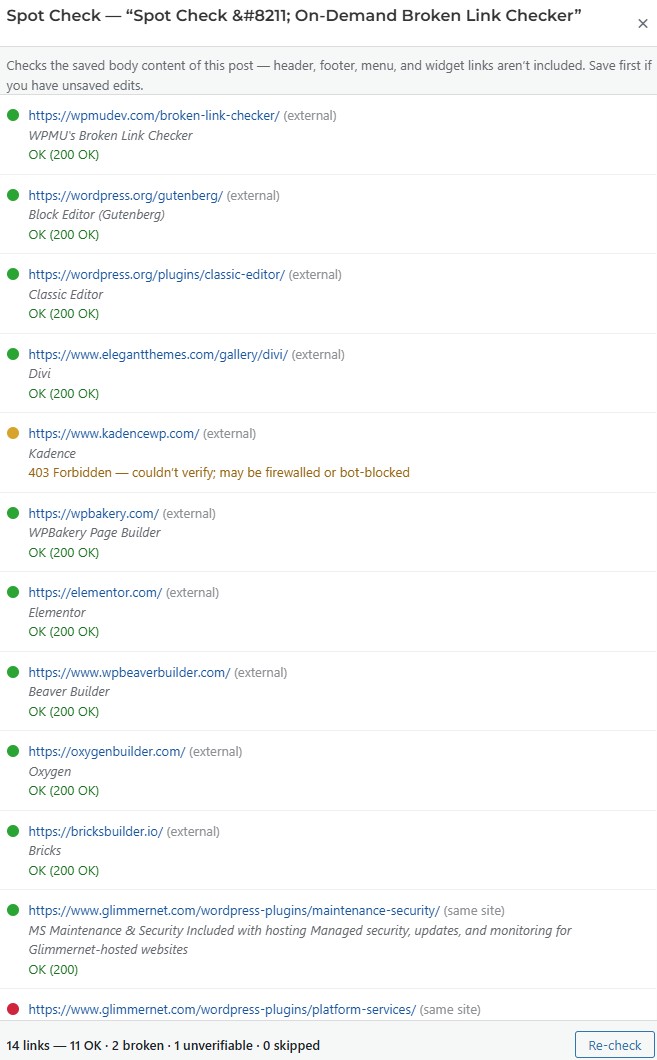
Spot Check reads the saved body of one post. That means the content you write in the editor. It does not check links in your header, footer, menu, sidebar, or widgets, because those live outside the post body. It also doesn’t see links created on the fly by dynamic blocks, like a “latest posts” block.
Page builders are a mixed bag, and it comes down to where each one keeps its content. Some store the page right in the post body, where Spot Check can read it. These work great:
Others keep their layout in a separate place, away from the post body. How much Spot Check catches depends on the builder — sometimes most of the links, sometimes only a few. It flags these builders with a note in the results, so you know to double-check. These include:
How the checking works
Links to your own site are checked right in your browser, which is fast and adds no load to your server. Links to other sites are checked by your server instead. This split is needed because of a browser security rule: browsers aren’t allowed to read responses from other websites, but servers are. Checks run a few at a time, and results appear as each one finishes.
05 — Settings
Spot Check Settings
Visit Settings → Spot Check to adjust a few things:
Post types. Spot Check works on all public post types by default, including custom ones. New types are turned on automatically. Untick any type to turn it off.
Request timeout. How long the server waits for an external link before giving up. The default is 8 seconds.
User-Agent. The browser identity sent with server-side checks. A realistic one helps avoid being mistaken for a bot. The default is fine for most sites.
Blocked responses. Choose whether “blocked” answers like 403 are treated as yellow (couldn’t verify) or red (broken). Yellow is the default, and we recommend keeping it.
06 — Frequently Asked Questions
Frequently Asked Questions about Spot Check
Probably not. Some sites block automated requests, and government and news sites do this a lot. They send “403 Forbidden” to robots but show the page to people just fine. Spot Check marks these yellow instead of red, which means “check this one yourself.” The link stays in future checks, so if the page ever truly dies, it will show up red.
Spot Check reads the saved body of one post. Header, footer, menu, sidebar, and widget links live outside the post body, so they’re not included. Most of the page body itself is covered — but see the next question for one exception.
Most likely a page builder added that link as the page loads, not when you saved. Spot Check reads your saved page content, where most links live, so it finds those. But some builders, like Elementor, keep their layout in a separate place. They turn certain links into real HTML only when a visitor views the page. Those links aren’t in your saved content yet, so Spot Check can’t see them. When it detects one of these builders, it shows a short note in the results, so nothing feels hidden. To check every link on the live page, run a full-site scanner like Broken Link Checker alongside it.
Your server checks security certificates more strictly than your browser does. Some sites have sloppy certificate setups that browsers quietly work around but servers refuse. When that happens, Spot Check tries once more with the certificate check turned off, then reports the real page status along with a note about the certificate problem.
Not in this version, and that’s a deliberate choice. Spot Check is built to be a safe, read-only diagnostic. It tells you what’s wrong and never touches your content, so there’s no chance of it damaging a page while trying to help. Editing links automatically is also harder than it looks. Popular builders like Divi and Elementor don’t store content as plain HTML. They wrap it in their own shortcodes and data structures, and each one is different. Changing a link safely, in every builder, without breaking the surrounding layout or corrupting the saved data, is a genuinely non-trivial problem. We’d rather ship it when we can promise 100% accuracy and 100% data integrity than rush a feature that might mangle your pages. A safe “fix this URL” feature is on the roadmap for exactly that reason.
No. Checks only run while the results panel is open, and the results are thrown away when you close it. The plugin stores one small settings row, which is deleted if you uninstall.